Chapter 2: The Digital PR Revolution
Key Takeaways - The internet transformed PR from a one-way broadcast into a two-way conversation, empowering audiences to engage directly with brands. - Key shifts include the rise of content marketing, the integration of SEO as a core PR function, and the real-time nature of social media. - Data analytics allows PR professionals to measure campaign impact through specific metrics: referral traffic, backlink growth, sentiment scores, and conversion rates. - The AI era introduces a new shift: from optimizing for journalists to optimizing for answer engines.
From Monologue to Dialogue
Traditional PR functioned as a monologue. Companies broadcast messages through mass media with limited channels for public response. The internet—particularly social media—transformed this into a dialogue.
Consider the difference: In 1995, a product launch feedback loop took weeks. In 2025, a brand knows exactly how a launch is received within hours. This shift isn't just about speed; it's about power dynamics. Audiences now have the ability to shape brand narratives, not just receive them.
The Rise of Key Digital Tactics
Content Marketing: Brands as Publishers
The internet enabled companies to function as their own publishers. Instead of just creating ads, brands now create content that provides direct value to their audience.
Content marketing is not about promoting your brand; it's about making other people's content better by providing useful material. In 2010, while building frameworks for Samsung, we found that bloggers wanted access and unique stories—not just press releases. That insight remains foundational today.
SEO as a PR Tool
PR professionals now recognize that earning mentions and backlinks from reputable websites is the most effective way to improve search rankings.
The Backlink-Authority Loop: 1. Create useful content (research or data). 2. Pitch to relevant journalists and creators. 3. Earn coverage with backlinks. 4. Improve search rankings. 5. Gain more organic traffic and new opportunities.
The Power of Social Media
Social media gives brands a direct line to customers for service and community building. It also gives customers a megaphone.
In the social media era, you have approximately 4 hours before a narrative hardens. The 24-hour news cycle is dead; we now operate in a 4-hour response window. Successful brands are those that respond fast, authentically, and without corporate jargon.
Influencer Marketing: The New Media
Online influencers reach specific, engaged audiences through voices those audiences already trust. Whether called bloggers, creators, or influencers, the principle remains: credibility is transferred from the individual to the brand.
Making Decisions with Data
Digital analytics tools enable the tracking of specific outcomes that traditional PR never could: - Referral traffic. - Backlink growth. - Sentiment scores. - Conversion rates.
Every campaign now has a trail of data that provides the accountability stakeholders demand.
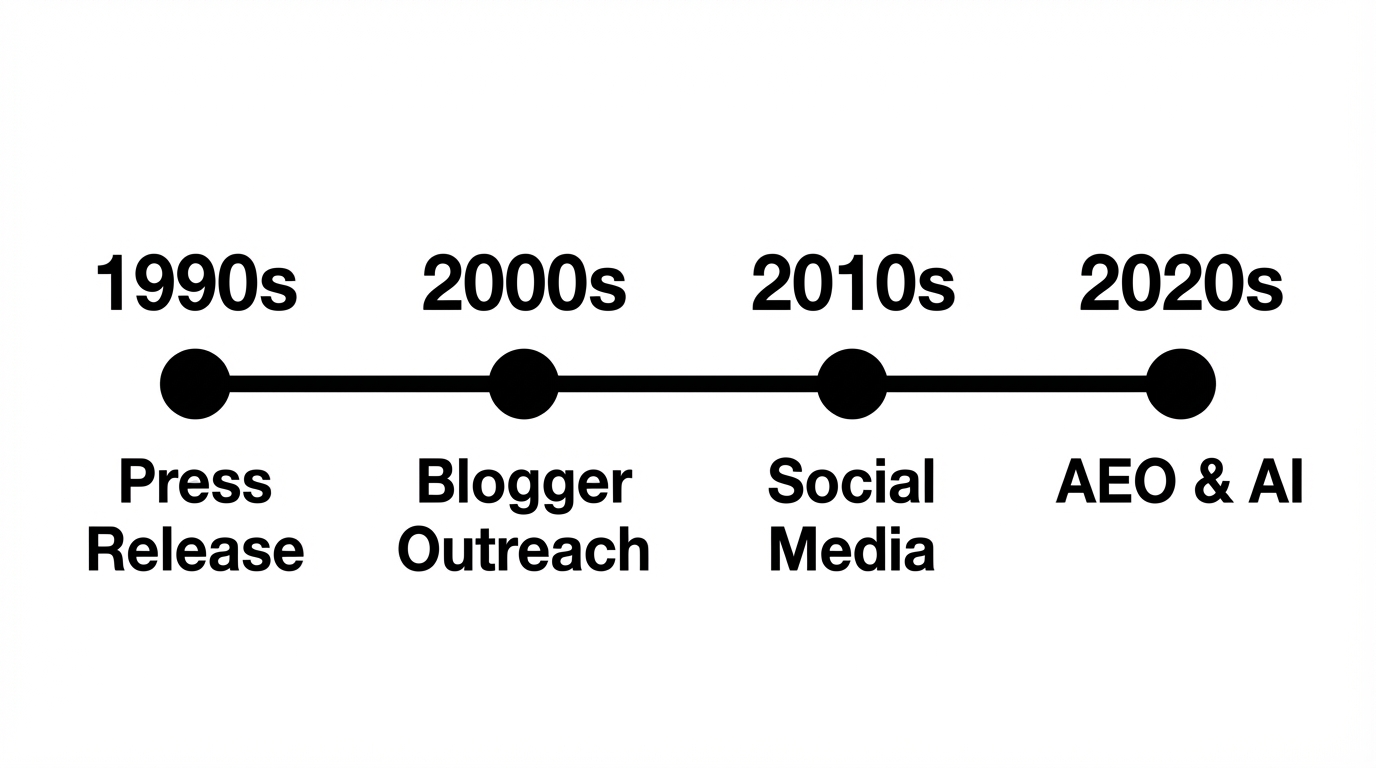
The Evolution of PR: A Visual Timeline
| Era | Key Characteristics | Primary Channels | Measurement |
|---|---|---|---|
| 1990s | Dawn of Digital | Email, basic websites | Clippings, reach estimates |
| 2000s | Rise of Social | Blogs, Facebook, Twitter | Comments, shares, mentions |
| 2010s | Content is King | YouTube, Instagram, SEO | Backlinks, traffic, engagement |
| 2020s | Data & AI | TikTok, AI tools, Analytics | Conversions, sentiment, ROI |
| 2025+ | Answer Engines | ChatGPT, Perplexity, AEO | Citations, entity authority |
The 2025+ era represents the current frontier. Digital PR is now the mechanism for building what AI systems understand as the truth.
The Modern PR Professional's Skillset
The evolution of Digital PR requires an expanded skillset: - Content creation and writing. - Foundational SEO principles. - Social media platform management. - Data analysis for strategic decision-making. - Understanding of AI and answer engines.
The Human Premium Relationships still matter. AI can draft a press release, but it cannot build trust with a skeptical journalist or read the room in a crisis. The practitioners who thrive are those who use AI for efficiency while doubling down on uniquely human skills: judgment, creativity, and strategic thinking.
The Shift Toward Accountability
The underlying shift over the last two decades has been from broadcasting messages to earning attention. The biggest change is accountability. In traditional PR, success was claimed based on estimated reach. Now, every campaign must show clicks, shares, and conversions.
The professionals who thrive today are those who have learned to read data, adapt quickly, and treat every platform as a conversation.
Chapter 2 Toolkit: The Digital PR Revolution
Practical Exercise: Then vs. Now Scenario
Imagine you are launching a new product. "Then" (1995): How would you have used traditional PR? "Now" (2026): List three digital channels, tactics, and how you would measure them.
Self-Assessment
Rate your understanding (1-5) of: - The shift from monologue to dialogue. - Content marketing as owned media. - SEO as a PR outcome. - Data-driven measurement.
DPRI CONNECTION
The Digital PR revolution created the demand for a systematic framework like the DPRI Method. It made PR-to-digital connections measurable for the first time.
Next: Chapter 3 explores the core principles that guide practitioners through this new landscape—principles that ensure our systems remain rooted in trust and honesty.