Chapter 45: Moment Marketing and The PR Stunt Planning Framework
Key Takeaways - Speed vs. Planning: Moment marketing requires real-time speed; PR stunts require calculated engineering. Both aim to break algorithmic noise. - The 3V Framework: A quick validation filter—is it Visual, Viral, and Values-aligned? - The 7 Stunt Archetypes: Proven models like "World's First," "Banned Ad," and "David vs. Goliath" provide a blueprint for viral success. - Risk Engineering: High-impact stunts carry inherent risk. The 4-Quadrant Risk Matrix helps navigate legal, brand, and execution dangers. - The "Intervention" Mindset: Successful stunts don't just interrupt; they intervene in culture to force conversation.
In the digital age, attention is a volatile asset. While consistent storytelling builds trust over time, PR Stunts provide the high-impact "interventions" required to break through algorithmic noise and force a spike in Branded Search Volume, Media Mentions, and Social Shares.
This chapter outlines how to move from "hoping to go viral" to "engineering outcomes" using structured frameworks for Moment Marketing and PR Stunts.
Moment Marketing vs. The PR Stunt
While often used interchangeably, these are distinct disciplines:
- Moment Marketing: The art of inserting your brand into existing conversations (e.g., a trending meme, a major sports event, a viral news story). Success depends on speed and relevance.
- The PR Stunt: The act of creating the conversation. It is a planned, engineered event designed to force media coverage and social engagement. Success depends on creativity and execution.
Both strategies share a common goal: transforming a brand from a passive "product provider" into a Culturally Relevant Entity.
Part 1: The Validation Filter – The 3V Framework
Before investing resources into a stunt or moment marketing idea, pass it through the 3V Framework. If an idea fails any of these three checks, it is likely to generate noise rather than value.
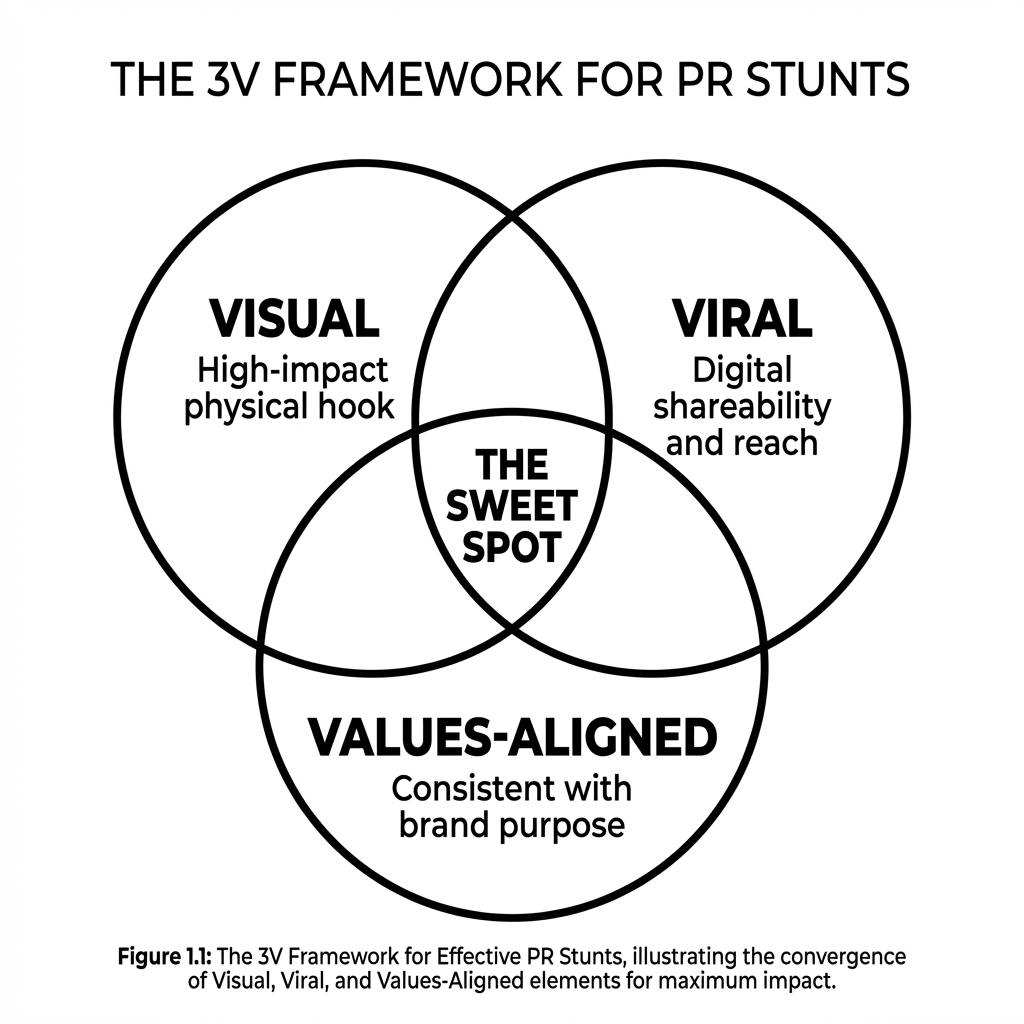
1. Visual (The "Instagram Moment")
Is there a clear photo or video opportunity for the media?
- The Test: Does the visual tell the story in a single image?
- Why it matters: In a scroll-based feed, text is secondary. If the visual hook is weak, the story will not spread.
2. Viral (The "Share Trigger")
Is the idea surprising enough that people will share it unprompted?
- The Test: Complete this sentence: "Did you see that [Brand] just ____?"
- Why it matters: Algorithms prioritize content that generates immediate engagement (shares, saves, comments).
3. Values (The "Brand Guardrail")
Does this align with our brand identity, or does it feel desperate?
- The Test: If the logo was removed, would this still feel like our brand?
- Why it matters: A viral mismatch can damage long-term reputation (e.g., a luxury bank trying to use a Gen Z meme).
Part 2: The PR Stunt Archetypes
Analysis of successful global campaigns reveals seven recurring "archetypes" or narrative structures. Use these as starting points for ideation.
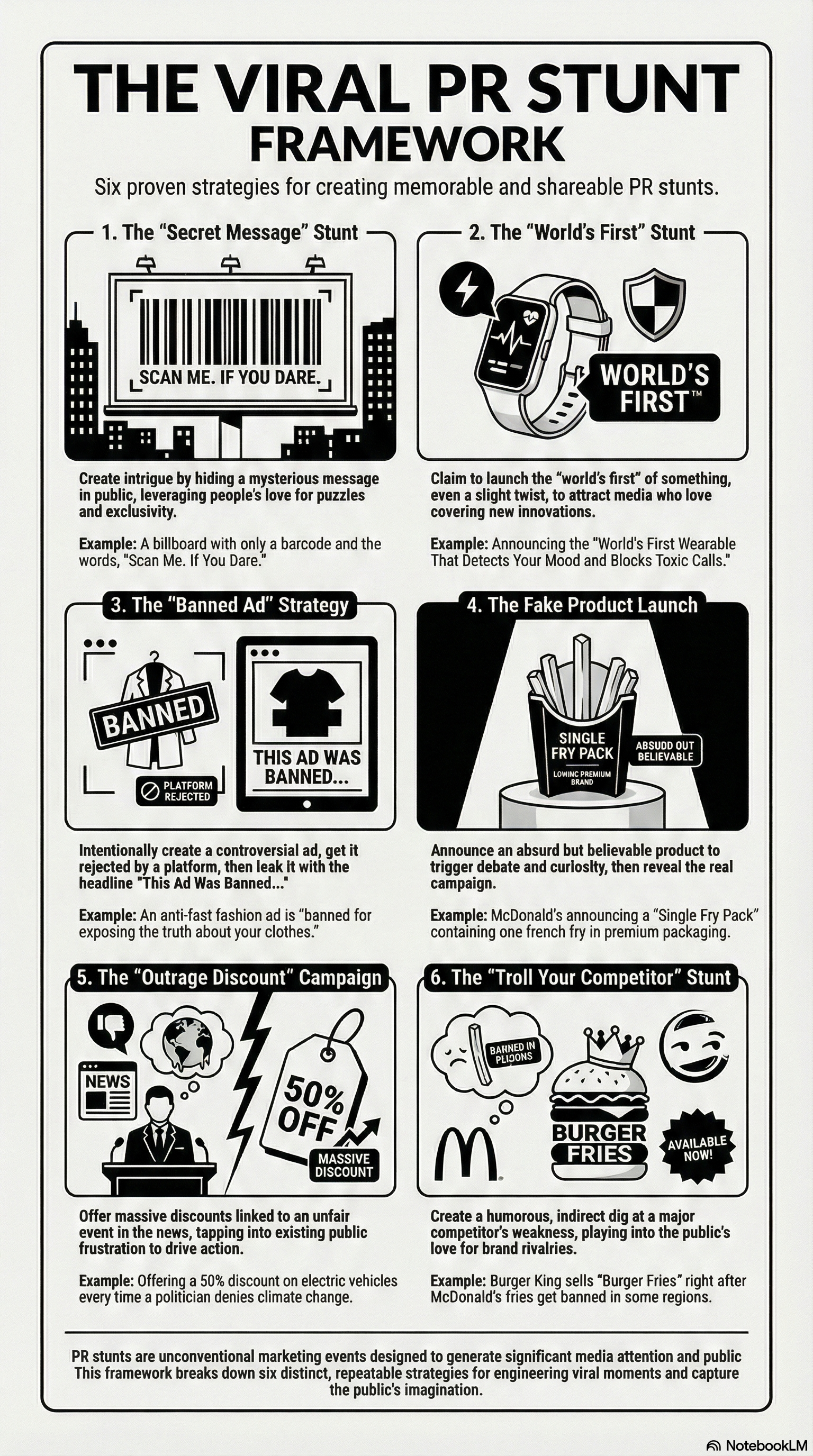
1. The "World's First" Claim
Concept: Claim pioneering status in a niche category to generate authority and news interest.
- Mechanism: Media outlets prioritize "firsts," and consumers are drawn to innovation.
- Example: "World's First AI-Generated Luxury Brand" or "World's First Biodegradable Sneaker."
- Requirement: The claim must be factually defensible to avoid a credibility crisis.
2. The "Manufactured Scarcity" Play
Concept: Create artificial limitation or exclusivity to drive urgency (FOMO).
- Mechanism: Scarcity triggers a psychological desire to participate before it's too late.
- Example: A product available for only 24 hours, or a "drop" limited to 100 units.
- Requirement: The scarcity must be strictly enforced. "Extending" the offer kills the trust.
3. The "Banned Ad" Strategy
Concept: Create content that is intentionally too controversial for traditional media, then "leak" it to drive curiosity.
- Mechanism: The "Streisand Effect"—attempting to censor something often draws more attention to it.
- Example: "This Anti-Fast Fashion Ad Was Banned for Exposing the Truth."
- Requirement: The content must be strategically controversial without crossing into genuine offense or hate speech.
4. The Fake Product Launch
Concept: Announce an absurd but believable product to spark debate and meme-ification.
- Mechanism: People love to debate "is this real?" on social media.
- Example: McDonald's announcing a "Single Fry Pack" (one fry in premium packaging).
- Requirement: A rapid "reveal" strategy is essential. Let the joke run too long, and confusion turns to anger.
5. The "Outrage Discount" Campaign
Concept: Tie promotions to newsworthy frustrations or "David vs. Goliath" narratives.
- Mechanism: Taps into existing public sentiment to drive immediate action.
- Example: A 50% discount on electric vehicles whenever a specific politician denies climate change.
- Requirement: Requires legal safeguards and a thick skin for potential backlash.
6. The "David vs. Goliath" Challenge
Concept: Position your brand as the underdog fighting a larger, faceless competitor.
- Mechanism: Humans are hardwired to root for the underdog.
- Example: A fintech startup offering a "Bank Fee Apology Generator" to mock traditional banks.
- Requirement: The tone must remain punchy and humorous, not bitter or aggressive.
7. The "Meme-ification" Stunt
Concept: Create a content format or physical object designed specifically to be remixed and shared.
- Mechanism: Reduces the friction of sharing; the audience does the distribution work for you.
- Example: Balenciaga's "Destroyed Sneakers" or the "Barbie Selfie Generator."
- Requirement: The asset must be open-source or easily editable by the public.
Part 3: The 5-Stage PR Stunt Development Process
Moving from a "wild idea" to a "executed campaign" requires a disciplined process.
Stage 1: Strategic Foundation (Discovery)
Define the business objective before the creative idea.
- Goal: Are we solving for Awareness (Views), Reputation (Sentiment), or Action (Leads)?
- Constraint: What is our budget, and what is our risk tolerance?
Stage 2: Concept Ideation (Creation)
Use the 7 Archetypes to brainstorm at least 20 ideas, then filter them through the 3V Framework. Select the top 3 for development.
Stage 3: Risk Assessment (Validation)
Every stunt carries risk. Use the 4-Quadrant Risk Matrix to evaluate your concept:
| Risk Level | Potential Issues | Mitigation Strategy |
|---|---|---|
| High | Regulatory violations, Values misalignment | Legal pre-clearance, Crisis response plan ready. |
| Medium | Grey area tactics, Minor controversy | Stakeholder sign-off, Phased execution. |
| Low | Fully compliant, On-brand message | Standard operational checks. |
- Kill Switch: Always have a plan to stop the campaign immediately if it spirals out of control.
Stage 4: Execution & Amplification (Launch)
A stunt does not spread itself. You need an Amplification Pyramid: 1. Owned Channels: The "Source of Truth" (Landing page, official social post). 2. Influencers: The "Spark" (Early access partners who share simultaneously). 3. Earned Media: The "Fire" (Press releases sent to journalists under embargo). 4. Viral Spread: The "Explosion" (Organic sharing by the public).
Stage 5: Measurement & Optimization (Analysis)
Don't just count likes. Measure business impact.
- Awareness: Media Mentions, PR Value Equivalent (AVE), Social Impressions.
- SEO: Branded Search Volume, New Backlinks, Keyword Rankings.
- Business: Traffic Spikes, Lead Volume, Conversion Rate.
Part 4: Real-World Case Studies
Case Study 1: TE-A-ME Teas – "Trumping Donald"
Archetype: Intervention / Newsjacking
- The Context: TE-A-ME Teas, an Indian challenger brand, wanted to break through a market dominated by giants.
- The Stunt: During Donald Trump's presidential campaign, they launched a "TE-A-ME Intervention," sending him 6,000 bags of Green Tea to "purify" him and help him relax. They projected this message onto flight paths.
- The Results:
- Reach: 650M+ impressions in 80+ countries.
- Traffic: 9,900% increase in organic website traffic.
- Business: 1,100% surge in international business inquiries.
- Why It Worked: It combined humor, a global news hook, and a simple visual ("Tea for Trump") to create a story that media outlets loved to cover.
Case Study 2: Revolt Motors – "Revolt Against Ordinary"
Archetype: World's First + Manufactured Scarcity
- The Context: Launching India's first AI-enabled electric motorcycle.
- The Stunt: They created the "World's First" motorcycle with customizable engine sounds (Roaring Tiger, F1 Car). They launched with a limited batch (Scarcity).
- The Results:
- Sold Out: 1,000 bikes sold in 120 minutes.
- Waitlist: 28,000+ people joined the waitlist.
- SEO: Dominated "electric bike India" search results.
- Why It Worked: The feature (custom sounds) was inherently shareable and visual (audible), solving the "silent EV" problem in a novel way.
Case Study 3: Balenciaga – "Destroyed Sneakers"
Archetype: Outrage Loop + Meme-ification
- The Context: Maintaining a reputation as a provocative luxury fashion house.
- The Stunt: Releasing "Fully Destroyed Sneakers" (ripped, dirty) for $1,850.
- The Results:
- Meme-ification: 10,000+ memes created organically.
- Search: 1,500% increase in "Balenciaga" searches.
- Sales: Sold out in 2 hours despite (or because of) the outrage.
- Why It Worked: The product was designed to be ridiculed. The outrage was the marketing strategy, reinforcing the brand's "anti-fashion" positioning.
Part 5: DPRI Connection – Stunts as SEO Fuel
In the DPRI Method, a stunt is not just a branding exercise; it is a technical SEO asset.
- Branded Search Spike: A successful stunt forces users to search for your brand name. Google interprets this spike as a strong signal of Entity Authority.
- Backlink Acquisition: Stunts generate high-authority news coverage (New York Times, TechCrunch) that naturally links back to the source. These are "natural" links that money cannot buy.
- Content Content: The assets created for the stunt (videos, landing pages) become long-term content assets that continue to drive traffic.
Module 8 Summary: Creativity in Digital PR is a discipline, not an accident. By applying these archetypes and validation filters, you move from "creative chaos" to "strategic intervention."
Next: Module 9 provides the worksheets and templates to turn these strategic frameworks into executed campaigns.
Chapter 45 Toolkit: Creative Strategy & Planning
Tool 1: The PR Stunt Brief Template
| Section | Key Question |
|---|---|
| Objective | What specific business problem does this stunt solve? |
| Archetype | Which of the 7 Archetypes are we using? |
| Visual Hook | Describe the single image/video that tells the story. |
| Share Trigger | Why will a user share this unprompted? |
| Risk Check | What is the worst-case scenario, and how do we mitigate it? |
Tool 2: The Stunt Ideation Worksheet
- Step 1: Brand Truth. What is one uncomfortable or surprising truth about your industry?
- Step 2: Emotion Trigger. Choose one: Outrage, Joy, Surprise, Curiosity, Pride.
- Step 3: Cultural Hook. What current event or trend can you connect to?
- Step 4: The Remix. Combine the above into a "World's First" or "David vs. Goliath" concept.
Tool 3: The Risk Assessment Checklist
- [ ] Does this violate any laws or regulations?
- [ ] Could this be misinterpreted as offensive to a specific group?
- [ ] Do we have a "Kill Switch" plan if backlash occurs?
- [ ] Is the website/infrastructure ready for a 100x traffic spike?